Starting a podcast in Jaipur in 2026 is not just about buying a mic and speaking your thoughts; it is about building a voice that people trust, remember, and come back to. If you are a business coach, consultant, trainer, founder, or entrepreneur, your audience is already searching for practical advice, real stories, and expert guidance online. The only question is whether they are hearing it from you or someone else.
So, if you have been wondering how to start a podcast without getting confused by equipment, editing, platforms, scripts, and studio setup, then read this blog till the end to know everything step by step.
Why Business Coaches in Jaipur Are Turning to Podcasting in 2026
If you are a business coach in Jaipur, you already know that trust is everything. People do not hire you only because you have a certificate, an Instagram page, or a few testimonials. They hire you because they feel you understand their problems and can guide them with clarity. This is where podcasting becomes powerful.
A podcast allows you to explain your ideas in depth. You are not limited to a 30-second reel or a short caption. You can talk about business growth, mindset, sales, leadership, money management, team building, personal branding, client acquisition, and real challenges that your audience faces every day.
And the best part is that your podcast works for you even when you are not actively selling.
When someone listens to your episode while driving, walking, working, or relaxing, they spend 20, 30, or even 60 minutes with your voice. That creates a deeper connection than most social media posts can ever create.
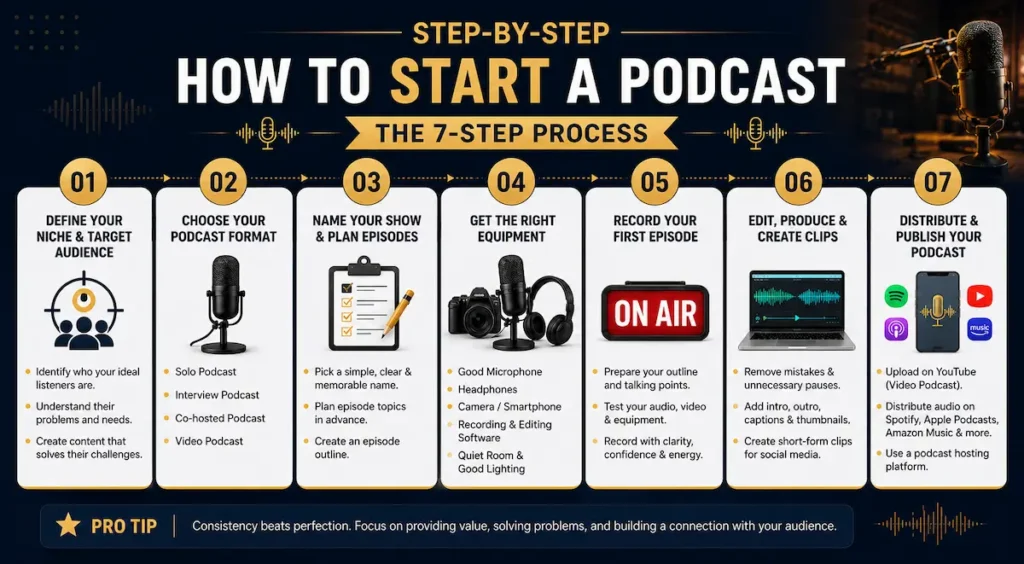
Step-by-Step — How to Start a Podcast (The 7-Step Process)
For your better understanding, we have listed a process where you will know how to start your podcast step by step:
1. Define Your Niche and Target Audience
Don’t try to speak to everyone. If you are a leadership coach for Jaipur’s manufacturing sector, speak directly to those CEOs. Define exactly who your listener is, what their daily struggles are, and how your podcast will solve them. You need to be specific.
For example, instead of starting a general business podcast, you can create a podcast for:
- First-time entrepreneurs in Jaipur.
- Small business owners who want to scale.
- Coaches who want to get more clients.
- Women entrepreneurs building service-based businesses.
- Startup founders learning sales and marketing.
When your niche is clear, your content becomes sharper. You know what problems to talk about, what examples to use, what guests to invite, and what kind of language your audience understands.
2. Choose Your Podcast Format
Once your audience is clear, you need to decide how your podcast will look and sound. There is no single perfect format. The best format is the one that suits your personality, your schedule, and your content goals. You can choose from formats like:
- Solo Podcast: This is where you speak directly to your audience. It is great if you are a coach, consultant, or educator because you can teach concepts, share frameworks, and explain your point of view clearly.
- Interview Podcast: Here, you invite guests and have conversations with them. This works well if you want to build your network, bring different perspectives, and create information-based content.
- Co-hosted Podcast: In this format, two people host the show together. It feels more conversational and relaxed, but it needs strong coordination.
- Video Podcast: This is becoming very popular in India because one recording can give you a full YouTube episode, Instagram reels, YouTube Shorts, LinkedIn clips, and audio content. For business coaches and entrepreneurs, video podcasting is often the smarter choice because your audience does not just hear you; they see your confidence, expressions, body language, and personality.
3.Name Your Show and Plan Your Episodes
Your podcast name should be simple, clear, and easy to remember. You do not need to make it overly creative or complicated. In fact, the clearer your name is, the easier it becomes for people to understand what your show is about.
For example, if you are a business coach, your podcast name could be built around themes like growth, leadership, scaling, mindset, business clarity, or entrepreneurship. Once the name is ready, do not jump straight into recording. First, plan at least 8 to 10 episode ideas. This gives you a strong starting point and helps you stay consistent after launch.
4. Get the Right Equipment
You do not need to spend lakhs to start a podcast, but you do need decent-quality equipment. If you are starting from home, you will need:
- A good microphone.
- Headphones.
- A quiet room.
- A camera or a good smartphone.
- Recording software.
- Editing software.
But equipment alone does not guarantee quality. Your room matters. Your mic placement matters. Your lighting matters. Your background matters. Your camera angle matters. Your sound treatment matters.
Many business coaches buy a mic and camera, record at home, and then wonder why the video still looks average or the audio sounds echoey. This usually happens because a home environment is not designed for professional recording.
So, if you are serious about using your podcast for brand building and client acquisition, you can either build a proper home setup or record in a professional podcast studio where everything is already ready for you.
5. Record Your First Episode
Your first episode will not be perfect, and that is completely fine. The goal is not perfection. The goal is clarity, confidence, and completion. Before recording, prepare your outline properly. Keep your phone on silent, drink water, check your mic, test your camera, and record a short sample first. When you start speaking, do not try to sound like a news anchor or a radio host; speak naturally. Your audience wants your real voice, not a fake performance.
6. Edit, Produce and Create Short-Form Clips
Recording is only the first half of your podcast. Editing is where your raw conversation becomes polished content. Good editing removes distractions like long pauses, repeated sentences, background noise, awkward gaps, and unnecessary parts. But you should not over-edit your podcast so much that it starts sounding robotic. For video podcasts, production also includes:
- Colour correction.
- Audio cleanup.
- Intro and outro.
- Captions.
- Thumbnail creation.
- Reel and short-form clip editing.
- Social media formatting.
This part is very important because your long podcast episode may not get discovered immediately, but your short clips can be noticed quickly by the audience.
7. Distribute and Publish Your Podcast
Once your episode is ready, you need to publish it where your audience can find it. You can upload video podcasts on YouTube and distribute audio versions on platforms like Spotify, Apple Podcasts, Amazon Music, and other podcast directories using a podcast hosting platform.
Home Studio vs Professional Studio — What Really Happens to Your Brand
A home studio sounds convenient in the beginning because you can record anytime, you do not need to travel, and you feel more relaxed in your own space. But when you are building a serious personal brand, convenience is not the only thing that matters. Your podcast also reflects your professionalism.
If your audio has echo, your video looks dark, your background looks messy, or your frame looks casual, your audience may not consciously notice, but they will feel the difference. For business coaches and entrepreneurs, this matters even more because you are not just creating entertainment, you are selling trust. And, recording in a professional studio gives you:
- Better sound quality.
- Clean video setup.
- Proper lighting.
- Professional background.
- Multiple camera angles.
- Technical support.
- Less recording stress.
- Faster production workflow.
- Better brand perception.
At home, you are the speaker, technician, lighting person, audio checker, camera operator, and editor. In a professional studio, you can focus on what you do best: speaking, teaching, sharing, and building connection.
This does not mean you can never record at home. You can. But if your podcast is directly connected to your business, coaching brand, or client acquisition strategy, then a professional setup can make a big difference in how people perceive you.
How to Grow & Monetise Your Podcast (The Strategy After Launch)
Launching your podcast is a first step, but growth comes from consistency and strategy. Many people record two or three episodes and then stop because they do not see instant results. But podcasting works like trust-building. It compounds over time.
To grow your podcast, you need to follow a simple method:
- Stay consistent: You can publish weekly, or even twice a month, but choose a schedule you can maintain. Consistency builds audience expectations.
- Repurpose every episode: Do not post only the full episode and wait. Create short clips, carousels, quotes, newsletters, and blog posts from it.
- Invite relevant guests: If you are a business coach, invite founders, marketers, finance experts, HR professionals, creators, sales trainers, and local entrepreneurs. Every guest brings a new audience and a new perspective.
- Optimise your titles and thumbnails: Good content still needs good packaging. Your title should create curiosity, and your thumbnail should look clean and professional.
- Add a clear call to action: If you want people to book a call, visit your website, join your workshop, follow your page, or download a resource, tell them clearly.
Now comes the monetisation part. Your podcast can help you earn directly and indirectly.
Direct monetisation can include sponsorships, brand collaborations, paid guest features, or platform revenue. But for business coaches, indirect monetisation is often more powerful. Your podcast can help you get coaching clients, consulting leads, workshop registrations, speaking opportunities, community members, and brand partnerships.
For example, if someone watches five of your podcast episodes and then books a consultation, they already trust you before the call. That makes your sales process easier and more natural. This is why your podcast should not only be treated as content. It should be treated as part of your business growth strategy.
Ready to Record? Here’s Your Next Step
Learning how to start a podcast in 2026 is really about learning how to build trust in your targeted audience’s mind. And by now, you understand that starting a podcast is not as confusing as it looks from the outside. You need a clear niche, a simple format, planned episodes, decent production, consistent publishing, and a growth strategy. But the real difference comes when your podcast sounds and looks professional from the first episode.
If you are a business coach or entrepreneur in Jaipur and you want to start your podcast, then you do not have to manage everything alone. We at Echorix Studio Jaipur are there to solve all your concerns related to shooting a podcast. Here, you get a professional podcast recording environment where you can focus on your work while the technical side is taken care of for you. Whether you are recording your first solo episode, inviting a guest, creating a video podcast, or planning content clips for social media, Echorix Studio gives you the space, setup, and support to make your podcast feel polished, confident, and ready to launch. Visit echorixstudio.com or call us at 9257106755 to book your session.
FAQs
1.How much does it cost to start a podcast in Jaipur?
If you do a home setup for a podcast, then you might spend ₹30,000-₹40,000 on basic equipment. Alternatively, booking a professional studio allows you to pay per session, often saving you the upfront cost of equipment.
2.Can I start a podcast without buying any equipment?
Yes, you can start a podcast without buying your own equipment if you record in a professional podcast studio. This is a practical option when you want good audio, proper lighting, clean video, and technical support from the beginning. It also helps you test podcasting seriously before investing in your own home setup.
3.How long does it take to record a podcast episode?
A 30-minute episode usually takes about 45–60 minutes to record and another 2–3 hours for basic editing.
4.Is video podcasting better than audio-only in India?
Absolutely. With the massive reach of YouTube and Instagram in India, having a visual component significantly increases your chances of being discovered by new clients.
5.Where is the best podcast studio in Jaipur?
The best podcast studio in Jaipur is one that gives you clean audio, professional lighting, a good-looking setup, comfortable seating, and technical support. Echorix Studio Jaipur is a strong option if you want a ready-to-record space for video podcasts, business interviews, coaching content, and creator-led shows. It helps you focus on your content while the studio team supports the production side.